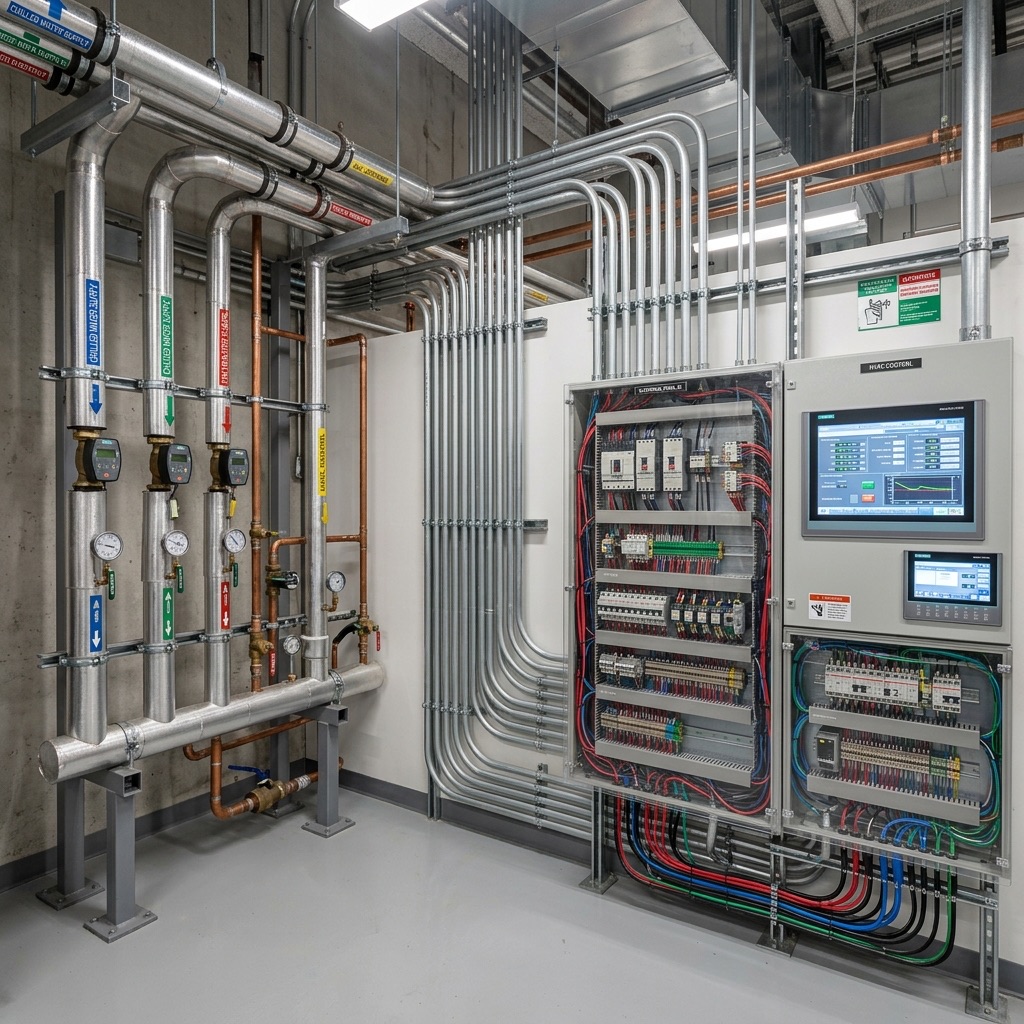
When dealing with the adaptation of an industrial warehouse, local shop renovations, or the legalization of air conditioning and electrical installations, a key question frequently arises: do I really need to hire an engineering project signed by a licensed engineer? In this article, we break down what this document consists of and detail the situations in which it is legally required by technical and industrial regulations.
What is an installations Engineering Project?
An engineering project is a comprehensive technical document composed of a descriptive memory, justifying calculations, terms and conditions, a detailed budget, and detailed layout designs. Its main objective is to define the technical characteristics of an installation to ensure that it complies with the Safety Regulations in force in Spain (such as the REBT for electricity, the RITE for air conditioning/heating, or the RIPCI for fire protection).
When is a Technical Installation Project Mandatory?
The obligation to hire an engineering project instead of a simplified technical report is determined by the power and size limits set by the Technical Regulations of the Ministry of Industry:
1. Low Voltage Electrical Installations (REBT ITC-BT-04)
It is mandatory to draft a technical approved electrical project for the following installations:
- Public Assembly Premises: Regardless of the contracted power (restaurants, bars, large stores, theaters, clinics, offices with an influx of public, etc.).
- Commercial Premises or Industrial Warehouses: With an installed electrical power exceeding **50 kW**.
- Residential or Commercial Garages: With forced ventilation or more than 5 parking spaces.
- Outdoor Installations and Street Lighting: With a power exceeding 5 kW.
2. Thermal, Air Conditioning and HVAC Installations (RITE)
In accordance with the Regulations of Thermal Installations in Buildings, an engineering project is required in:
- Heating, cooling, or air conditioning installations with a nominal generation thermal power exceeding **70 kW**.
- Solar thermal installations with a power exceeding 70 kW.
3. Fire Protection Installations (RSCIEI / CTE)
Applies to all industrial warehouses and warehouses with industrial or commercial activities according to their fire load risk level. It is also required in commercial premises with significant capacity and differentiated fire sectors.
Benefits of Having a Technical Engineering Project
Although it may initially seem like an additional bureaucratic step, the technical project brings direct value to the owner:
- Legality Guarantee: Avoids problems, delays, and unfavorable inspections before Industrial Inspection and Control Entities (EICI/EAC).
- People's Safety: Ensures that electrical systems, protections, emergency exits, and HVAC are sized with appropriate safety factors.
- Execution Cost Savings: By precisely defining materials in plans and specifications, inflated quotes from installers or the purchase of unsuitable equipment are avoided.