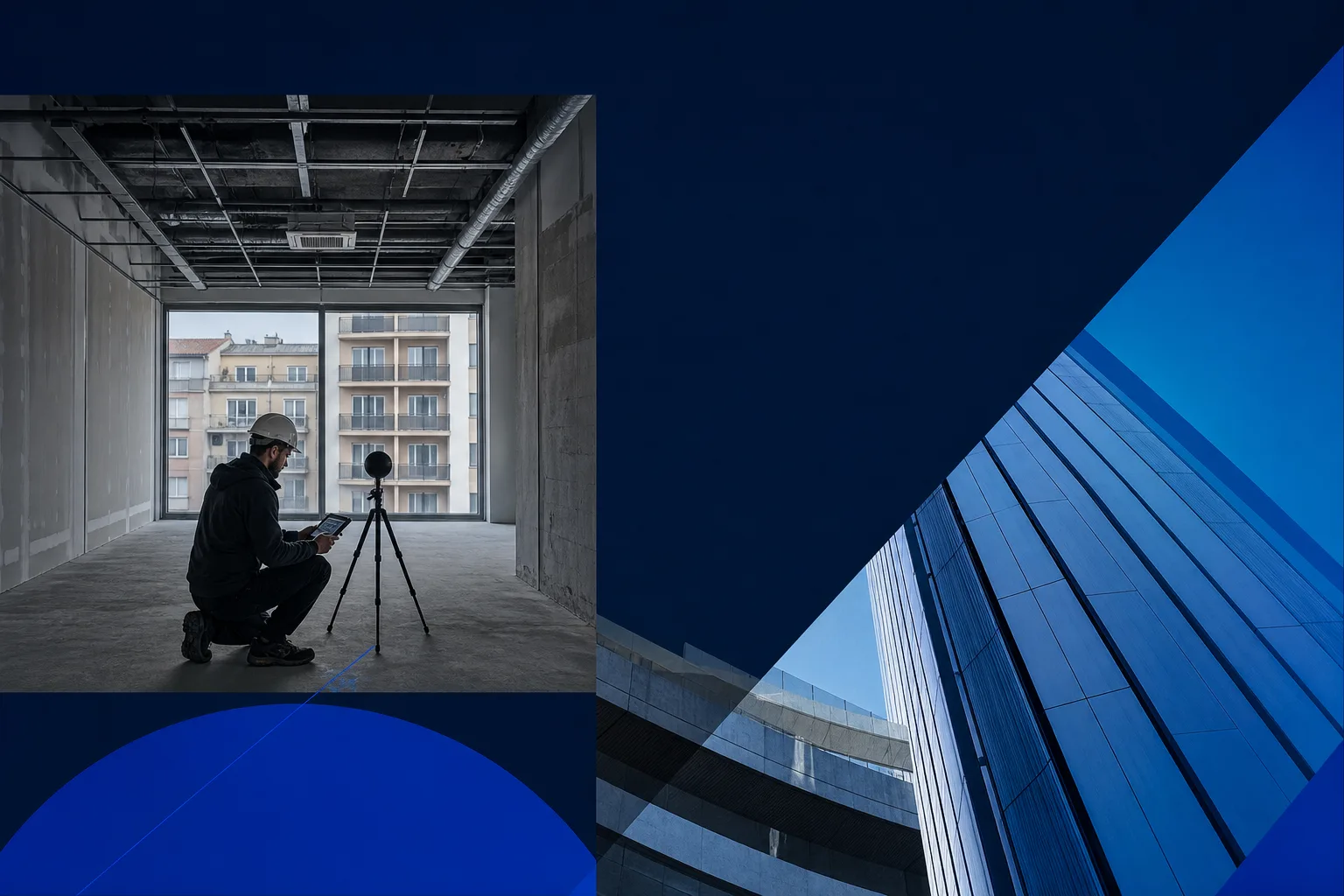
Not every business in Barcelona needs the same acoustic documents. The answer depends on the actual activity, its administrative classification, opening hours, music, machinery, ventilation equipment, vibrations and proximity to homes or other sensitive receivers. A declaración or comunicació prèvia, broadly meaning a prior notification, does not automatically remove acoustic obligations.
The safest time to assess acoustic feasibility is before signing a lease or finalising the refurbishment. An acoustic impact study, a noise measurement, an insulation design, a completion certificate and a sound limiter with recorder serve different purposes. Establishing which ones apply early can prevent ceilings, floors, service penetrations or ventilation systems from having to be redesigned later.
What an acoustic impact study is — and what it is not
An acoustic impact study is a technical assessment of how the proposed premises will operate. It identifies sources of noise and vibration, considers transmission routes and nearby receivers, estimates the resulting impact and explains the measures needed to meet the applicable requirements. Barcelona’s environmental ordinance requires the assessment to address matters including the premises, adjoining uses, nearby homes, expected internal and external levels, insulation and corrective measures where compliance cannot otherwise be demonstrated. [1]
It is not the same as taking a single sound reading. A predictive study evaluates the proposed activity; an insulation design specifies construction details; measurements or tests establish performance under defined conditions; and a final certificate records the checks required after the works. Acoustic treatment inside a room is also different from sound insulation: absorbent panels may reduce reverberation without adequately protecting neighbours.
- Impact study: assesses sources, receivers, transmission and expected compliance.
- Insulation design: specifies floors, ceilings, linings, doors, silencers and vibration isolation.
- Measurement or test: records levels or performance using the applicable method.
- Completion certification: documents the relevant checks after installation or building work.
- Sound limiter with recorder: controls and logs music-system output but does not soundproof the premises.
When an acoustic study may be required in Barcelona
Barcelona’s acoustic ordinance requires an impact study to accompany municipal licence applications for potentially noise-emitting activities identified in its specific list. The examples include certain singing, dance and music schools. The list should not be treated as a universal shortcut: the exact activity, current classification and applicable municipal route must be checked together. [1]
Noise alone does not determine whether the procedure is an activity licence, a form of prior notification or another route. Barcelona’s OMAIIAA municipal ordinance distinguishes between licensing and several notification arrangements, with different technical documents and controls. Its annexes were amended in 2024 and may change again, so applicants should consult the current City Council text and relevant Canal Empresa guidance before preparing the file. [3] [7]
- Check whether the precise activity is listed as potentially noise-emitting.
- Establish whether there will be amplified music, performances or musical activity.
- Identify homes above, below, beside or across an internal courtyard.
- Include impacts, motors, extraction and air-conditioning as well as voices and music.
- Confirm the current administrative classification even if the activity uses prior notification.
Businesses and noise sources needing particular attention
A bar or restaurant may generate music, conversation, furniture movement, extraction noise and outdoor transmission through doors or grilles. Gyms and dance schools can add weights, jumps and structure-borne impact; music schools involve instruments, voices and extended practice periods; and workshops may have machinery, compressors, shutters and handling operations. The trading name alone cannot establish acoustic feasibility.
Public establishments used for musical entertainment or activities must have a sound limiter with a recorder to prevent the music system from exceeding the established limits. The device does not compensate for inadequate building insulation and does not necessarily control customers, moving furniture, impacts or mechanical equipment. It therefore forms one part of the overall acoustic justification rather than replacing it. [2]
- Airborne sound: speech, music, instruments and machinery.
- Impact noise: weights, jumps, knocks and furniture movement.
- Vibration: pumps, compressors, motors and equipment fixed to structural elements.
- External transmission: façades, doors, courtyards, terraces, grilles and exhaust outlets.
- Indirect transmission: ducts, junctions, equipment supports and service penetrations.
What to check before leasing or refurbishing premises
Start by defining the real operation rather than using a broad description such as “restaurant” or “gym”. Record the proposed hours, occupancy, music or performances, equipment, deliveries and the operating pattern of ventilation and extraction. Then inspect adjoining homes and premises, internal courtyards, party walls, floor slabs, façades and shared structural elements. The municipal acoustic capacity map and the wider Catalan framework for acoustic zones are also relevant to the assessment. [5]
Existing acoustic linings or a similar former use do not prove that the premises are suitable. Request available drawings, test reports, certificates and refurbishment records, but verify whether they match the new activity and present condition. If insulation is designed after the fit-out, completed ceilings, walls, floors and ducts may require alteration; additional construction can also reduce clear height or usable floor area.
- Locate homes above, below and beside the premises, including those facing courtyards.
- Record loudspeakers, extract fans, air-conditioning units, pumps, compressors and impact areas.
- Inspect likely weak points around shutters, doors, façades, ducts and service penetrations.
- Check whether floating floors, independent linings, acoustic doors or silencers are physically feasible.
- Coordinate acoustic measures with ventilation, fire safety, accessibility, escape routes and layout.
A practical process for preparing the acoustic documentation
First, define the activity and confirm its administrative route. Next, prepare an inventory showing each source’s position, operating period and likely transmission path. Review the building and receivers, assess existing insulation and determine whether inspections, tests or measurements are needed. The impact study can then justify expected compliance and, where this cannot initially be demonstrated, set out the necessary corrective measures. [1]
Coordinate those measures with the refurbishment before closing walls or ceilings. Keep product data, equipment specifications and installation details, especially for isolated supports, suspended ceilings, floating floors, doors, silencers and ductwork. Depending on the activity and procedure, final measurements, technical certification, limiter configuration or control-body involvement may follow. A licence or prior notification does not remove the continuing duty to comply while operating. [1] [8]
- Do not confuse room treatment with insulation protecting adjacent properties.
- Do not assess music while overlooking extraction, impacts, machinery and vibration.
- Do not mount loudspeakers or plant directly on structural elements without evaluating transmission.
- Do not conceal ducts or service penetrations before checking their acoustic treatment.
- Review the assessment before changing equipment, speakers, layout, hours or operating methods.
Frequently asked questions
Must measurements be taken inside a neighbouring home?
They may be required when premises are in or next to a residential building and the assessment must address the most affected internal dwelling. Access to someone else’s property cannot be assumed. The appropriate strategy depends on the procedure, the condition of the premises and the applicable measurement method, so it should be agreed with the competent technical professional and checked with the authority or any
How much does an acoustic study cost, and how long does it take?
The available official sources do not support a standard price or timescale. Both depend on the premises, number of sources and receivers, available records, required measurements, construction complexity and administrative documents. Authority processing times may also vary by procedure and any requests for further information. Obtain a case-specific scope and consult the current official procedure rather than
Does a prior notification avoid an acoustic study or later inspections?
No. The applicable route must be established from the activity classification and relevant municipal and sector-specific rules, not only from expected noise. Where required, a prior notification must include documents demonstrating compliance. The operating business must continue to meet the justified conditions, and changes to equipment, music, layout, hours or use may require the acoustic assessment to be reviewed.
Do you need an engineering project or permit in Barcelona?
We assess feasibility, prepare the technical documents and support you throughout the application.