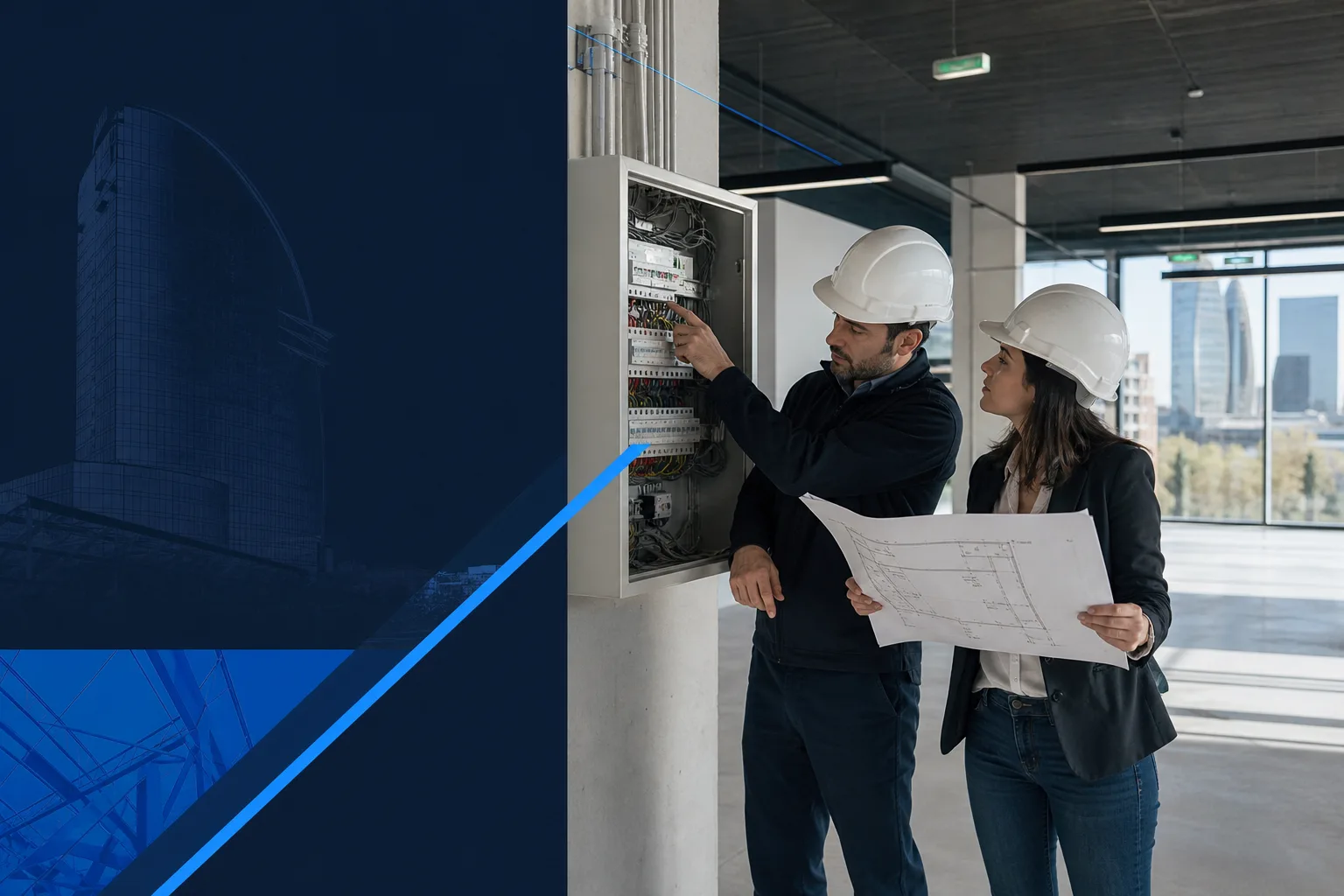
A business that admits customers is not automatically a “local de pública concurrencia” under Spain’s Low Voltage Electrotechnical Regulation, known as the REBT. This is a specific electrical classification, which can be translated descriptively as public-access premises. It depends on the intended activity, the areas used by the public and the applicable occupancy criteria. Establishing the classification before signing a lease or approving refurbishment work can reveal whether an electrical project, an initial inspection or substantial alterations will be required.
If the premises fall within this category, the electrical installation requires a project and a favourable initial inspection before it is commissioned. In Catalonia, the technical documents must also be coordinated with the responsible declaration and the registration or updating of the installation in RITSIC, the Catalan register of technical safety installations. An active electricity supply or an old installation certificate does not, by itself, prove that the installation is suitable for a new activity.
What “public-access premises” means under the REBT
“Local de pública concurrencia” is a technical classification under the REBT rather than a general description of every place open to visitors. ITC-BT-28 covers entertainment and recreational premises, as well as certain meeting, workplace and healthcare premises. It also addresses other cases according to factors such as their use and anticipated occupancy. The trading name alone—shop, studio, clinic or office—is therefore insufficient to determine the classification. [1]
The assessment must reflect the actual premises and intended operation. For example, an office without visitors is not equivalent to an office with a customer waiting area. Nor should a small shop automatically be treated in the same way as a restaurant, gym or healthcare centre. These examples are only indicative: the conclusion must be based on the current text of ITC-BT-28 and the specific layout, activities and users of the property. [1] [4] [7]
It is also important to distinguish the activity’s permitted capacity from anticipated occupancy for electrical purposes. Capacity may be affected by evacuation, fire safety and the configuration of the premises. Electrical occupancy is used when applying the REBT. The figures may be connected, but they should not be assumed to be identical without confirming which rule and purpose apply to each calculation. [1] [4]
How to determine whether your premises are included
Start by defining the activity and mapping every relevant area, rather than relying on a broad description such as “retail” or “office”. Identify sales floors, reception and waiting areas, classrooms, consulting rooms, changing rooms, event spaces, storage rooms and staff-only areas. Mixed premises require particular care because different zones may have different uses and patterns of access.
Employees should not always be added automatically to customer numbers. The Spanish Ministry of Industry’s official REBT guidance states that, for the criterion concerning commercial establishments with occupancy exceeding 50 people, the relevant figure is public occupancy. This prevents an automatic classification based on combining customers and staff, although a complete assessment is still necessary where other uses or conditions apply. [4]
A practical pre-lease assessment should follow a clear sequence: define the proposed activity and layout; calculate occupancy using the appropriate criterion; compare the result with ITC-BT-28; establish the electrical use previously documented for the premises; and compare the existing installation with the requirements of the new business. Where the answer is unclear, it should be resolved before committing to a lease or a fixed refurbishment budget. [1] [3] [4]
- Define the precise activity and any secondary uses.
- Review a plan showing public, staff and technical areas.
- Calculate occupancy for the relevant regulatory purpose.
- Check the previous electrical use and RITSIC details.
- Assess whether the existing installation can support the proposed layout and equipment.
What changes when the premises fall within this category
Electrical installations in public-access premises require a technical project, irrespective of their power rating within this category. The project defines and justifies the design and must be prepared and signed by a suitably qualified competent technician. It is not the same as a technical design report, or memoria técnica de diseño, which is used for installations that do not require a full project under the applicable rules. [1]
The work must be carried out by an authorised electrical installation company. On completion, the relevant documents include the works management and completion certificate and the electrical installation certificate. Public-access premises must also undergo an initial inspection by an authorised control body—commonly called an OCA—before commissioning. Installations requiring an initial inspection are subsequently subject to periodic inspections every five years. [1] [5]
The physical alterations cannot be established from the classification alone. Depending on the premises, the assessment may cover distribution boards, circuits, protective devices, wiring, emergency lighting, maximum admissible power and any required safety supply. Compliance is not normally demonstrated by replacing one isolated component; the affected installation must be assessed against the proposed use and the relevant technical provisions. [1] [7]
- Technical project prepared by a competent professional.
- Installation work by an authorised electrical contractor.
- Works management and completion certification where applicable.
- Favourable initial inspection by an authorised control body.
- Electrical installation certificate and subsequent administrative filing.
Documents, responsible declaration and RITSIC registration
For a new Catalan installation requiring a project, the documentation includes the responsible declaration, technical project, works management and completion certificate, and certificate issued by the authorised installation company. Where an initial inspection is required, its favourable certificate must also be retained. The holder should possess the technical records themselves; an electricity bill or confirmation that the meter is active is not an adequate substitute. [5] [6]
Under Catalan Decree 192/2023, commissioning, extension, modification, change of holder, amendment of details and decommissioning of a low-voltage installation are processed through a responsible declaration. Installations are identified by a number recorded in RITSIC. RITSIC is the register of installations and should not be confused with RASIC, which records industrial safety agents such as authorised companies and control bodies. [3]
Before leasing, ask for the RITSIC registration number or certificate, the project or technical report, the installation certificate, the completion certificate, initial and periodic inspection reports, and any available diagrams or plans. Also check the documented maximum admissible power and registered use. Forms, electronic procedures, fees and document templates can change, so the current requirements should always be confirmed through Canal Empresa and the Portal Jurídic de Catalunya before filing. [3] [5] [6]
- RITSIC installation number or registration certificate.
- Electrical project or technical design report.
- Electrical installation certificate.
- Works management and completion certificate.
- Initial and latest periodic inspection certificates, where applicable.
Existing premises, likely cost items and avoidable mistakes
Existing premises generally present three situations. If the activity and electrical use remain the same, check the documentation, inspection status and any later alterations. If only the holder changes, process the registration change and confirm that the documented installation matches the actual one. If the activity results in a change of electrical use, Catalan Decree 192/2023 requires that change of use to be processed as a new installation; merely changing the holder will not be sufficient. [3]
A reliable cost cannot be stated without knowing the floor area, layout, activity, occupancy, power requirements, installation condition and available records. Budget items may include an initial survey, project preparation, works management, contractor labour, distribution boards and circuits, emergency lighting, the control body’s inspection, administrative processing and correction of defects. Building work or changes to the service connection, meter arrangement or communal elements may add further costs.
Common mistakes include treating an old certificate as proof that the installation suits every activity, reusing the previous operator’s capacity figure, confusing public occupancy with total headcount, and starting refurbishment before confirming whether a project is required. Another frequent risk is processing only a change of holder when the use has changed. An early technical review allows the electrical work to be coordinated with fire safety, accessibility, ventilation and activity authorisation requirements. [3] [4]
- Do not assume an old certificate covers the proposed activity.
- Do not reuse a previous capacity or classification without checking it.
- Do not order electrical work before defining the regulatory scope.
- Do not increase power without checking the documented maximum.
- Allow for inspections, document recovery and possible defect correction.
Frequently asked questions
Is every shop open to customers classed as public-access premises?
No. The activity, configuration and anticipated occupancy must be assessed under ITC-BT-28. For the official criterion concerning commercial establishments with more than 50 people, the Ministry’s guidance refers to public occupancy rather than automatically combining customers and employees. Other activities may fall within the category under different criteria.
Do public-access premises need an electrical project and OCA inspection?
Yes. The REBT requires an electrical project for installations in public-access premises and an initial inspection by an authorised control body before commissioning. These installations are then subject to periodic inspections every five years. The consolidated rules and current Catalan procedure should be checked when the application is prepared.
What if the premises already have electricity and an installation certificate?
An active supply and an earlier certificate do not prove suitability for a different activity. Check the registered use, project or technical report, installation and completion certificates, inspection history and subsequent alterations. In Catalonia, a change of electrical use must be processed as a new installation under Decree 192/2023.
Do you need an engineering project or permit in Barcelona?
We assess feasibility, prepare the technical documents and support you throughout the application.