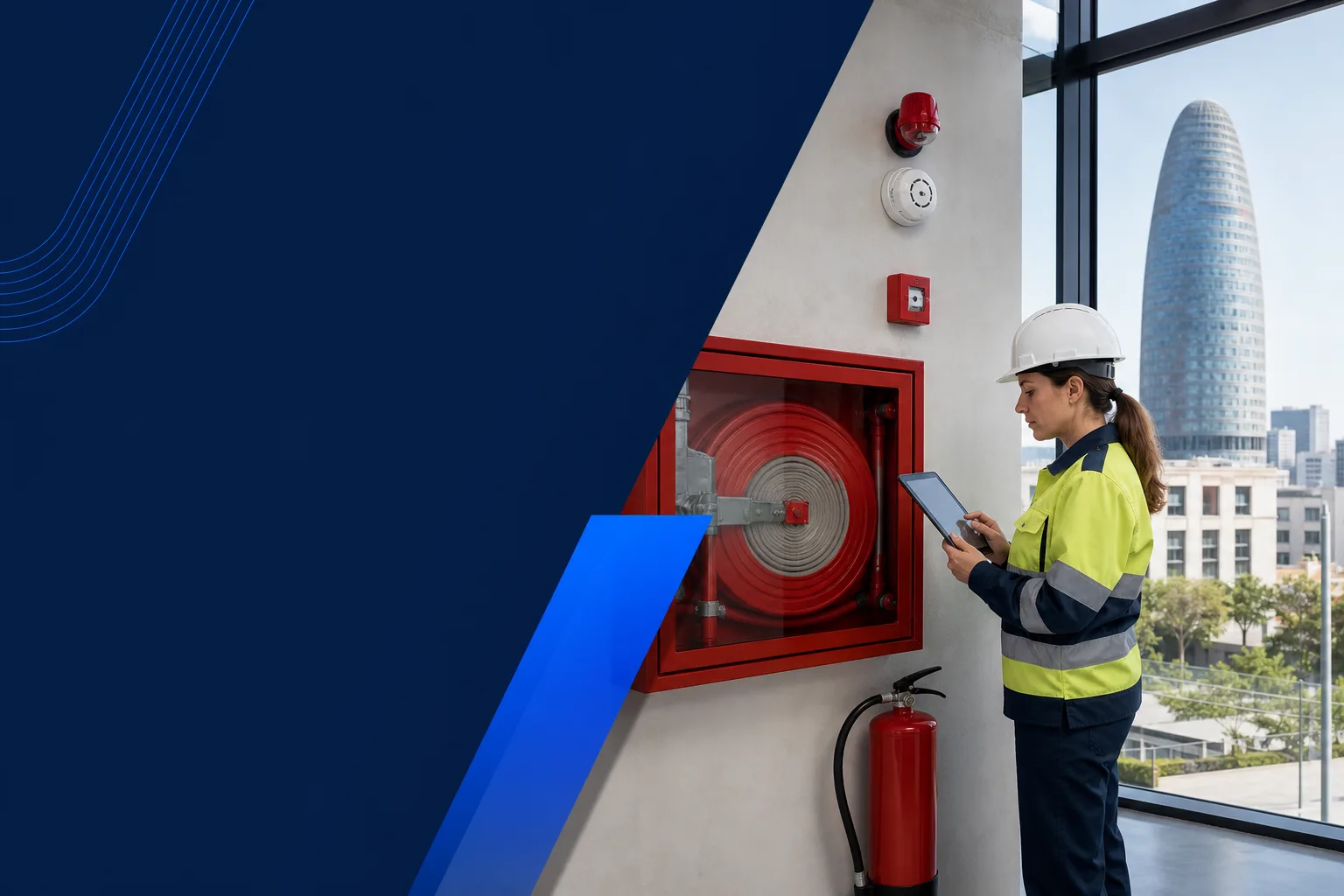
Keeping extinguisher, fire hose reel or detection-system maintenance up to date does not prove that the statutory inspection requirement has been met. Maintenance and periodic inspection are separate obligations. Maintenance keeps systems operational, whereas an inspection by an authorised control body assesses whether the installation and its documentation comply with the applicable regulations.
To determine whether a periodic fire protection inspection is due in Barcelona or elsewhere in Catalonia, first classify the establishment as industrial or non-industrial. Then check its regulated use, floor area, installed systems, commissioning date and any specific rules. The answer is not always “every ten years”: industrial establishments follow a different regime, while exemptions for smaller premises are subject to important conditions.
Maintenance, statutory inspection and activity controls are different
Equipment and systems covered by the RIPCI, Spain’s Fire Protection Installations Regulation, must undergo the maintenance operations in Annex II. Maintenance records must remain available to the authorities for at least five years. Where a statutory periodic inspection is required, the operator must request it from an authorised control body, commonly called an OCA, which issues a separate inspection report. A maintenance contract therefore does not replace the inspection. [1]
Neither procedure should be confused with a municipal inspection, a fire-safety verification connected with an activity licence, or a preventive fire control procedure. These controls have different purposes and may involve different authorities. Before commissioning work, identify exactly which obligation must be demonstrated: equipment maintenance, periodic inspection of the installation, inspection of an industrial establishment, or an activity-related control.
- Maintenance: services and checks the installed equipment and systems.
- Periodic RIPCI inspection: assesses regulatory compliance through a control body.
- Activity-related control: checks fire requirements associated with an administrative activity procedure.
- Industrial inspection: may cover the building configuration, passive protection, active systems and maintenance records.
How to identify the applicable inspection deadline
For a non-industrial installation not governed by another specific inspection regulation, the RIPCI requires the operator to arrange an inspection by a control body at least every ten years. The period is linked to commissioning. If there is no commissioning date, the national technical guide identifies completion of the installation as the reference. Do not automatically use an equipment invoice, manufacturing date, lease date or change of operator without confirming that it is acceptable for the relevant file. [1] [7]
Industrial establishments are governed by the regulation approved through Royal Decree 164/2025 and must generally be inspected at least every five years. The inspection can assess changes of activity, establishment type and configuration, fire sectors and areas, intrinsic risk level, correspondence with the approved project, passive fire protection, active systems and maintenance. Transitional provisions apply to older establishments, and a limited exception exists for certain very small, low-fire-load cases only where all regulatory conditions can be demonstrated. [2]
- Confirm whether the registered activity is industrial.
- Review the project and the regulations applied when the premises were commissioned.
- Check whether a sector-specific regulation sets another inspection regime.
- Find the documented commissioning or installation-completion date.
- Do not assume that a sale, lease or change of operator restarts the period.
Exemptions based on use, floor area and installed systems
Article 22 of the RIPCI exempts residential housing from its general periodic inspection requirement. Subject to the stated conditions, it also exempts administrative and educational premises below 2,000 m², and commercial, public assembly and car park uses below 500 m². The wording is “below”, not “up to”: commercial premises measuring exactly 500 m² do not fall within the exemption for areas under that threshold. [1]
Floor area alone is not enough to establish an exemption. It does not apply where the premises contain high special-risk rooms or areas, or areas used for storage. The RIPCI also addresses installations consisting solely of certain equipment referred to in Article 20.2 or emergency lighting, unless another regulation requires inspection. Consequently, it is unsafe to conclude that premises with “only extinguishers” are automatically exempt without checking their actual use, storage areas, risk classification and any other applicable rules. [1]
- Residential housing: exempt under Article 22.
- Administrative and educational use: below 2,000 m².
- Commercial and public assembly use: below 500 m².
- Car parks: below 500 m².
- High special-risk or storage areas may prevent the exemption from applying.
Documents to prepare before requesting an OCA inspection
Depending on the installation, the Generalitat de Catalunya states that the operator should hold the responsible declaration, project or other technical documentation, installation certificate, maintenance certificates and service records, a contract with an authorised maintenance company, proof of registration in the RITSIC and certificates from inspections carried out during the installation’s service life. RITSIC is Catalonia’s register of technical industrial-safety installations. Reviewing this file before booking the visit can reveal missing documents or inconsistencies that need technical assessment. [3]
Check all changes made since commissioning, including extensions, revised layouts, changes of activity, increased storage, added or removed equipment and altered fire compartments. During a purchase or business transfer, compare the physical installation with the registered activity, operator details, project and certificates. There is no universal inspection price in the cited official sources. Cost can depend on the type and size of the premises, systems and sectors inspected, available records, the control body’s tariff and any remedial or documentation work required.
- RITSIC number or registration evidence and current operator details.
- Project, technical report, plans and installation certificate.
- Maintenance contract, certificates and service records.
- Report from the previous statutory inspection.
- Records covering subsequent alterations to the premises or systems.
Missing RITSIC registration and unfavourable inspection reports
RITSIC and RASIC are not interchangeable. RITSIC records technical industrial-safety installations in Catalonia. RASIC is the register used to verify industrial-safety agents, including relevant authorised companies and control bodies. A statutory inspection must be carried out by a control body authorised for the corresponding field; the maintenance company performs a different role, although it must also hold the applicable authorisation. [3] [5]
Article 9 of Catalan Decree 192/2023 provides a route for registering certain older fire protection installations that remain in use but are absent from RITSIC. Under the Generalitat’s December 2025 clarification, qualifying installations dating from before Royal Decree 513/2017 require an inspection by a control body and a simplified technical report signed by a competent technician. The former 2019 instructions have been repealed, so owners should check the current Generalitat procedure and download the latest forms before preparing an application. [4] [6]
An unfavourable report will identify non-compliances and the period allowed for correction. Under the general RIPCI regime, the control body reports very serious defects, and defects not corrected by the deadline, to the industrial authority. For industrial establishments, the period specified for correcting significant deficiencies cannot exceed six months. A serious and imminent risk leads to a negative classification and notification to the competent authority. The exact next steps should follow the inspection report and current official guidance. [1] [2]
- Confirm the installation’s age and whether it is genuinely absent from RITSIC.
- Inventory all available plans, certificates, maintenance records and alteration documents.
- Ask a competent technician whether a simplified technical report is applicable.
- Complete the control-body inspection required by the relevant procedure.
- Submit the registration using the current Generalitat forms and retain the resulting records.
Frequently asked questions
Does annual extinguisher servicing replace the periodic inspection?
No. Maintenance keeps equipment operational and produces maintenance records. When a statutory inspection is required, an authorised control body carries it out and issues a separate report. Compliance with one obligation does not automatically demonstrate compliance with the other.
Is a 450 m² shop always exempt from a RIPCI inspection?
Not necessarily. Commercial premises below 500 m² may fall within the Article 22 exemption, but the actual regulated use, storage areas, high special-risk areas, installed systems and any other applicable regulation must be checked first.
Can an inspection proceed if the project or RITSIC record is missing?
Missing records should be assessed before the inspection is arranged. Catalonia has a procedure for certain older installations absent from RITSIC, involving a control-body inspection and a simplified technical report. Eligibility depends on the installation’s age and circumstances, so consult the Generalitat’s current criteria and forms.
Do you need an engineering project or permit in Barcelona?
We assess feasibility, prepare the technical documents and support you throughout the application.