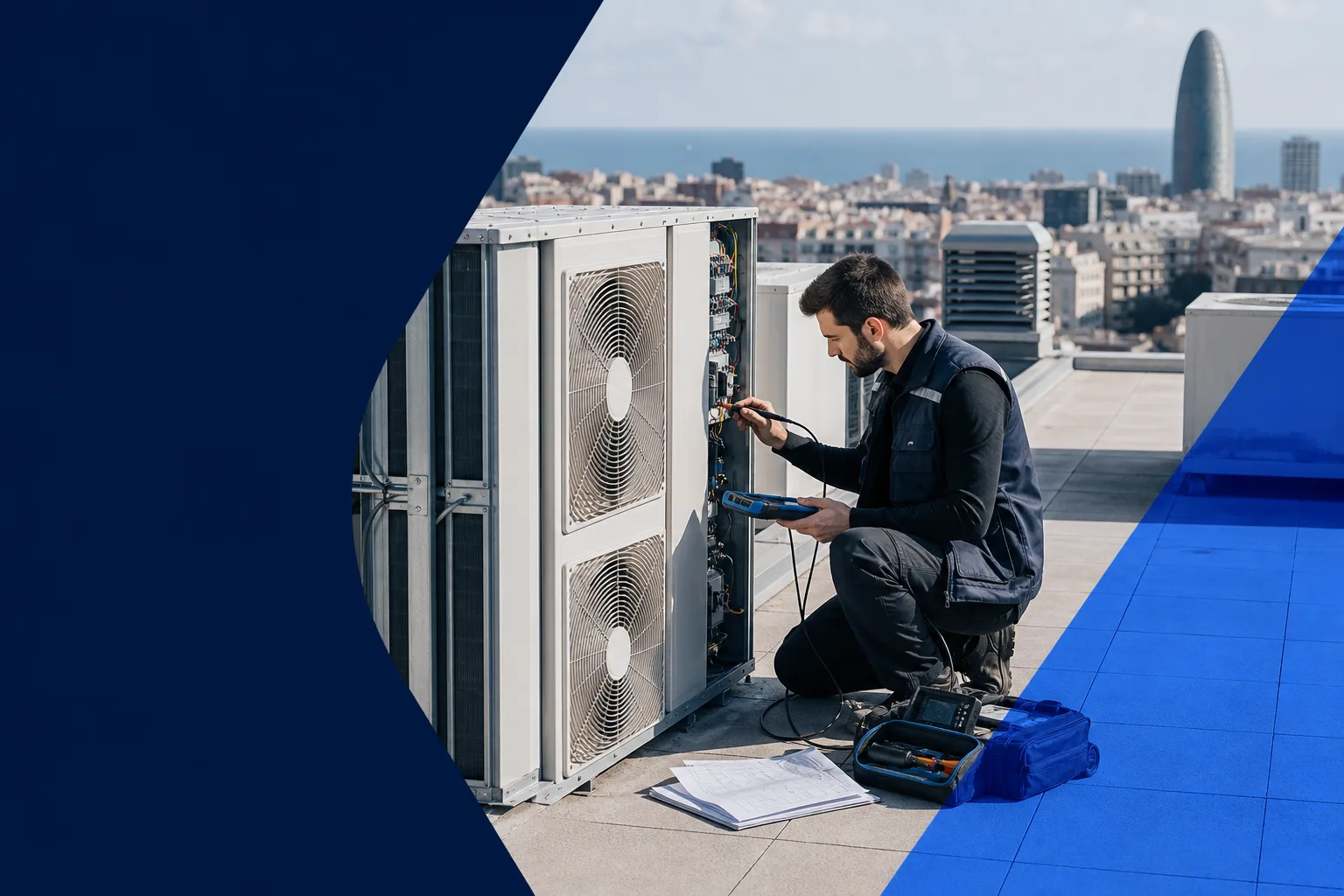
To legalise air conditioning in Barcelona, you need to assess the installation as a whole rather than simply checking the model of one unit. The required route depends on whether the work is a new installation, extension, replacement or alteration, its applicable nominal thermal output and whether outdoor units or associated building work require a separate municipal procedure.
The key thresholds are straightforward: below 5 kW, a project or technical report is not mandatory for demonstrating compliance to the regional authority; from 5 to 70 kW inclusive, a RITE technical report is required; and above 70 kW, a technical project is required. In Catalonia, heating and air-conditioning installations rated at 5 kW or more must also be processed for registration in the RITSIC industrial safety register. This registration does not replace planning for municipal works or business activity requirements.
What does legalising an air-conditioning installation involve?
RITE, Spain’s Regulation on Thermal Installations in Buildings, covers fixed heating, cooling and ventilation systems intended to provide thermal comfort and hygiene for people. It applies to new installations, the altered parts of existing systems and their maintenance, use and inspection. It can therefore apply to homes, commercial premises, offices and centralised systems serving an entire building. [4] [5]
Legalisation is not a single certificate. Depending on the installation, it may involve technical design through a report or project, execution by an authorised installer, certification and submission of a responsible declaration for entry in RITSIC, the Catalan Register of Industrial Safety Installations. Thermal installations must be carried out by qualified professionals working through companies authorised and registered in the relevant RASIC field. [4] [8]
Municipal works and business activity procedures must be considered separately. Installing equipment on a façade or roof, drilling through building elements or affecting communal areas may require intervention by Barcelona City Council. For commercial premises, the system may also form part of the activity documentation. Neither an installer’s certificate nor RITSIC registration automatically completes these separate procedures. [7]
- Define the complete installation and scope of work.
- Appoint an authorised thermal-installation company.
- Prepare the required RITE technical report or project.
- Obtain the installation certificates, equipment documents and manuals.
- Check RITSIC, municipal works and business activity requirements separately.
Use nominal thermal output to decide between a report and a project
The classification uses nominal thermal output, not the electrical input shown as energy consumption. Where several generators serve the installation, RITE requires the nominal outputs of the heat generators to be added together or, separately, those of the cooling generators needed to provide the service. Heating and cooling capacities should not simply be combined as one figure. Use the manufacturers’ technical data and the actual system configuration for this assessment. [5]
An installation rated at exactly 70 kW remains within the technical-report band: a project becomes mandatory only when the relevant output exceeds 70 kW. In Catalonia, heating and air-conditioning installations rated at 5 kW or more require a responsible declaration and RITSIC registration. Falling below 5 kW removes the specific obligation to present a report or project to the regional authority, but it does not remove other technical, refrigeration-safety or municipal requirements that may apply. [4] [5]
- Below 5 kW: no mandatory project or technical report for demonstrating compliance to the regional authority.
- From 5 to 70 kW inclusive: RITE technical report and RITSIC registration.
- Above 70 kW: technical project and RITSIC registration.
- Multiple units: assess nominal heating outputs or nominal cooling outputs separately, as applicable.
Replacements and alterations: check the scope before installation
Replacing a split system or heat pump is not automatically exempt. The Generalitat treats several types of work as alterations, including adding or modifying subsystems, increasing the number of generators, changing the energy source, incorporating renewable energy, changing the building’s intended use and replacing a generator. Its guidance also includes replacement with equipment of similar characteristics, so each case should be assessed by reference to the work and the resulting installation. [4]
Before purchasing equipment, collect the technical data sheets for every generator and describe all proposed work. Check whether refrigeration safety requirements may also apply because of the system’s design or refrigerant. Where an alteration must be registered, the responsible declaration must be submitted before the modified installation is put into service. [6]
A practical sequence is to classify the system before ordering or mounting it. This helps prevent a mismatch between the selected equipment, the proposed documentation and the permitted location of outdoor units. It also allows the thermal installation to be coordinated with a wider refurbishment or the opening of commercial premises without assuming that one procedure covers every obligation.
- Identify whether the work is new, an extension, replacement, energy change or change of use.
- Collect data sheets for all heating and cooling generators.
- Calculate the applicable nominal thermal output.
- Confirm whether a report or project is required before work starts.
- Check façades, roofs, penetrations and communal elements before positioning outdoor units.
Documents, online registration, costs and timing in Catalonia
For registrable installations up to and including 70 kW, the Generalitat lists a technical report, installation certificate, operation and maintenance manual, and documentation for materials and equipment. The file also includes the relevant CE certificates, the air-conditioning refrigeration circuit leak-tightness certificate and, where applicable, the latest maintenance certificate. The owner should retain the required records throughout the installation’s service life, even when every document is not uploaded with the initial form. [6]
For installations above 70 kW, the documentation includes the project, a certificate covering technical supervision and completion, and a maintenance contract with a company registered in RASIC or an equivalent register. The operation and maintenance manual, equipment records, CE certificates, leak-tightness certificate and applicable maintenance documentation must also be retained. [6]
The responsible declaration for commissioning, alteration or decommissioning is submitted online only. The official page consulted states an administrative fee of €11.65, but fees, forms and submission requirements can change, so verify them on Tràmits Gencat immediately before applying. Online submission produces an identifier and entry number. The official source does not give a fixed period in which the final RITSIC certificate is guaranteed to be issued, so no reliable completion date should be assumed. [6]
- Keep the technical report or project.
- Retain installation and completion certificates, as applicable.
- Archive manuals, equipment data, CE documentation and the leak-tightness certificate.
- Keep the online receipt and subsequent RITSIC certificate.
- Maintain any required maintenance contract and maintenance certificates.
Municipal permission in Barcelona and a final pre-installation checklist
Barcelona City Council determines the type of municipal intervention according to the property’s location and the exact work proposed. Its consulta prèvia, or preliminary works enquiry, identifies whether the route is an assabentat, a prior notification, a licence or another procedure, and indicates the documents required. The enquiry is free, remains valid for six months and may require information such as the cadastral reference and the works budget. [7]
The preliminary enquiry is particularly relevant where the work includes outdoor units, drilling or intervention on a façade, roof or other building element. For business premises, the installation should also be coordinated with the activity procedure. Industrial registration does not replace the municipal works route, while municipal permission does not replace RITE compliance or RITSIC registration. [7]
There is no official all-inclusive price for legalising an air-conditioning system in the sources reviewed. In addition to the current regional fee, the total may include a technical report or project, technical supervision, equipment, installation, maintenance, municipal procedures and related building work. Request an itemised scope and check current regional and municipal charges through the official portals rather than relying on a generic price estimate. [6] [7]
- Do not use electrical consumption instead of nominal thermal output.
- Do not assess only one unit where the system has several generators.
- Do not classify exactly 70 kW as requiring a project automatically.
- Do not treat the installer’s certificate as equivalent to RITSIC registration.
- Do not commission a registrable alteration before submitting the responsible declaration.
Frequently asked questions
Does an installation rated at exactly 70 kW require a technical project?
Not solely because it reaches 70 kW. Under the RITE threshold, installations from 5 to 70 kW inclusive require a technical report. A project is required when the applicable nominal thermal output exceeds 70 kW. The figure must be calculated using nominal thermal output and the regulatory method for multiple generators.
Should the output of every air-conditioning unit be added together?
Where there are several generators, add the nominal thermal outputs of the heat generators or, separately, the cooling generators needed to provide the service. Do not use electrical input or indiscriminately combine heating and cooling capacities. Review the technical data sheets and how the units operate as one system.
Is the installer’s certificate the same as RITSIC registration?
No. The installation certificate is part of the technical documentation, whereas RITSIC registration is processed through the relevant responsible declaration. Neither document replaces any municipal works or business activity procedure. The owner should retain the technical certificates, submission receipt and RITSIC certificate.
Do you need an engineering project or permit in Barcelona?
We assess feasibility, prepare the technical documents and support you throughout the application.